A one-page picture of where weida stands. Written for a reader who wants to see the shape of the project before reading the detail; every number and status here is taken from NIGHTLOG.md, BACKLOG.md and IMPLEMENTATION.md at the commit named below, and those files remain the source of truth. The diagrams live in docs/status/ and are plain SVG; regenerate them by hand when the picture changes.
Snapshot: main at fa13dbb, 2026-09-15 16:22 UTC. Tree clean; the LOOP.md §6 gate is green on Linux: 1882 passed, 0 failed, 37 ignored across the workspace, plus 854 passed across the five default-off feature configurations (284 + 245 + 152 + 143 + 30), both required clippy configurations, and the workspace plus all ten explicit rustdoc configurations after cargo clean --doc. weida-py adds 32 tests through a freshly built wheel. The four tests since the previous snapshot are B-203's settlement proofs: a reported delivery leaves, a report lost with its subscription requeues, max_unsettled stops and resumes one subscription, and an unsettled message keeps its charge. Mutations that removed the requeue, the bound or the charge each made the corresponding claim fail.
Every surface of the library is now bound. PAIR, SURVEY and BUS landed in the library ahead of its facades and B-244 carried them into weida::blocking and both halves of weida-py; B-243 did the same for the cursor surface, so a Python producer orders report=[weida.PROCESSED] on a send and reads the verdict a one-way transfer has no reply to carry. Two shapes were decisions rather than translations, and both came out the same way: a survey is a value in Python (weida.Survey) and a cursor report is a handle read in a while (set := await cursors.changed()) is not None: loop — because the only channel out of a bridged future there is the errno family, so async for would need a second one invented for StopAsyncIteration alone. A cursor level is an integer, since the level space is open above weida.APPLICATION_FLOOR and a class would close what the protocol leaves open.
A synchronous wait without a deadline is a hang, and B-243 found one of ours. The blocking Cursors::changed(deadline) is mandatory-deadline for the reason 0009 §4.4 gives: a peer that never reports opens no stream, a report that never starts never ends, and a connection both sides keep alive never closes, so a parked thread would wait forever. The library gained Cursors::changed_within(deadline) and Reported::{Changed, Waiting, Ended} — three outcomes, because a deadline is not an ending — and weida.sync.Cursors.changed(seconds) raises TimeoutError. A mutation test that parked for 300 seconds before the change fails in 15 after it.
A 64-byte message is now twelve bytes of framing. The guide's own C8B arithmetic found a fixed 60-byte traceparent on every DATA header of every pattern — 44 % of the wire budget for a message-to-everybody — and 0028 settled it on the honest argument rather than the byte count: a minted root is not a safe default but a fabricated fact, because a hop that received a context and forgot to propagate it emitted a new trace rather than nothing. A context is now propagated and never minted, so a 64-byte push is 76 B at 192.6-195.9 Kmsg/s against 135 B before, and weida is in ZMTP's and SP's class on small messages instead of 71 bytes worse (B-246).
There is now a document that teaches. GUIDE.md is organised around one question — C8B: how do you scale a software system to eight billion people?, this project's C10K, utopian on purpose — and every program in it is a file in the tree that a test drives (0026). §0's arithmetic is the part that earns the framing: at this repository's own measured numbers, two to four hops reach everybody, which makes the hard problem at that scale neither throughput nor depth but what a hop may claim — and an acknowledgement per recipient converging on one root is 1.1 TB for one message. Chapters 1 and 2 are written — ten claims exercised by the guide test — and the remaining broker chapters are filed slice by slice (B-258..B-261). The former cross-protocol chapter was removed with the rejected general bridge product category. Guarantee negotiation remains explicit: a live connection carries the set its runtime configured, and a peer requiring more is refused at connect time rather than silently given less (0027). Two document corrections came with it: HELLO keys 5 and 6 are on the wire, retiring a stale "spec ahead of code" caveat, and the website item had been sitting at ready for three rounds after the site shipped.
The fan-out width the whole argument rests on is now measured (B-247), and it moved the argument rather than confirming it. Per subscriber: 396-436 KiB of transport state at widths 16 and 256, 88.8 ns of publisher CPU per message, 507-539 µs of median idle latency at width 256. So neither memory nor CPU binds at 10⁴ subscribers — the delivery rate does, at 276-279 Kcopies/s, which is 36 ms of a node's capacity for one message to 10⁴ subscribers and about 27 messages per second at that width. The width interval in the guide survived (10³-10⁴) for a different reason than the one it was derived from. A second measured answer settles how a fan-out fails: a stalled subscriber is refused by the byte budget when that budget is below the connection's 0.6-1.5 MiB absorption band and by the queue when it is above it — which is why dropped_on(topic) separates the two causes. The latest successful Windows proof remains d26da7e: 1853 passed across 142 binaries, 0 failed and 37 ignored, with fmt, both clippy configurations and rustdoc clean. It is not a proof of this snapshot: the VM was rebuilt after the btrfs/QEMU cache fault was fixed and the fresh guest currently has no cargo, rustc, git or MSVC, so the manual gate cannot run until its toolchain is restored. The old result and its twelve storage-shaped failures stay in the nightlog rather than being presented as current evidence.
There are six Python bindings: the five competitor libraries plus weida-py, each with an asyncio and a synchronous surface on the shared weida-py-core foundation. The newest one is the first that reaches every weida pattern and its cursor surface. Thirty decision notes (0001–0030): fourteen accepted and sixteen provisional. The newest two are 0029, which separates a relayed report from a hop-local certificate, and 0030, which fixes Phase C's order as Python, Node, Erlang, C, Java.
One binary, weida (B-060), sits beside the library, and weida::blocking (B-194) beside the async API. Twenty-five [workspace] members, read from cargo metadata: weida-core, weida-protocol, weida-runtime, weida-winpipe, weida, weida-broker, crates/raft/weida-raft, crates/py/{weida-py-core, weida-py}, then crates/zmq/{weida-zmtp, weida-zmq, weida-zmq-py}, crates/nng/{weida-sp, weida-nng, weida-nng-py}, crates/mqtt/{weida-mqtt-codec, weida-mqtt, weida-mqtt-py}, crates/amqp/{weida-amqp-codec, weida-amqp, weida-amqp-py}, crates/nats/{weida-nats-codec, weida-nats, weida-nats-py} and crates/site. Since this snapshot crates/openbao/weida-openbao has joined and crates/site has left (0033): the site is built from this document set in its own repository, and the count is still twenty-five.
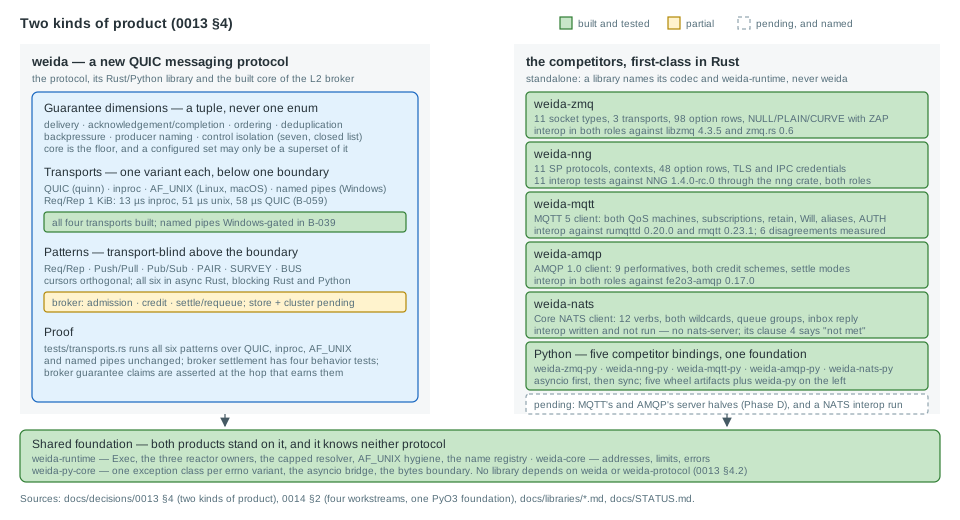
The two halves of that picture are the two products of 0013 §4: weida on the left, with the guarantee dimensions, transports and patterns it offers, and the five standalone foreign-protocol libraries on the right. They share runtime foundations but no implicit semantic conversion.
1. The roadmap
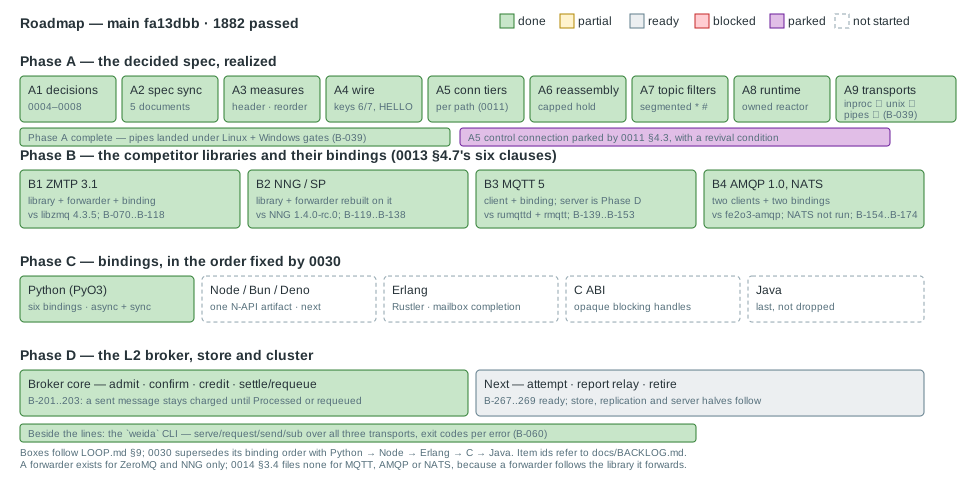
Reading it: Phase A is complete. Its last slice, named pipes (A9, B-039), waited for a Windows runner rather than for a design, and landed the day one existed: the same 0012 grouping over \\.\pipe\, gated on the VM beside the Linux gate. The control-connection tier (A5) is not a gap: decision 0011 parks it with a revival condition, because no existing or reserved frame is peer-scoped. The last open question in it, what a local open does at its ceiling, is answered: it waits for a slot, so Block means the same thing on every transport (B-059).
Phase B is complete across all four slices, and Phase C's Python row is complete across all six bindings. The sixty-six items of 0014 built the five competitor libraries and their bindings, each binding following its own library, asyncio first and synchronous second:
- B1 ZeroMQ —
weida-zmqandweida-zmq-py: eleven socket types againstzmq_socket(3)'s twenty rows, three transports, NULL/PLAIN/CURVE with the ZAP dialog, a 98-row option table decided row by row, the monitor, the devices, nine zguide recipes and interop in both roles against libzmq 4.3.5. - B2 nanomsg SP —
weida-nngandweida-nng-py: one socket type per protocol, the endpoint engine, a 48-row option table, TLS and IPC credentials, and eleven interop tests against NNG 1.4.0-rc.0 through thenngcrate. That interop found two library bugs no unit test had. - B3 MQTT 5 —
weida-mqttandweida-mqtt-py, a client: the server half is Phase D (0014 §2), so its parity table adds a fourth verdict and says why. Interop ran against two brokers,rumqttd0.20.0 andrmqtt0.23.1, and measured six disagreements with the specification. - B4 AMQP 1.0 and Core NATS —
weida-amqp,weida-natsand both bindings: nine performatives, both credit schemes, the settle modes and dispositions, interop in both roles againstfe2o3-amqp0.17.0 — and NATS interop written and not run, because nonats-serverwas reachable, which its parity table records as a clause not met rather than rounding up.
What that leaves in Phase C is the order fixed by 0030: Node, Erlang, C, Java. Phase D is no longer untouched: the in-memory broker admits and confirms, delivers under cumulative credit, and settles or requeues a delivery. DATA key 12, report relay and retire(deadline) are the three ready continuations; stores, replication, MQTT's and AMQP's server halves and AMQP 0-9-1 clients remain later Phase D work.
2. What exists, layer by layer
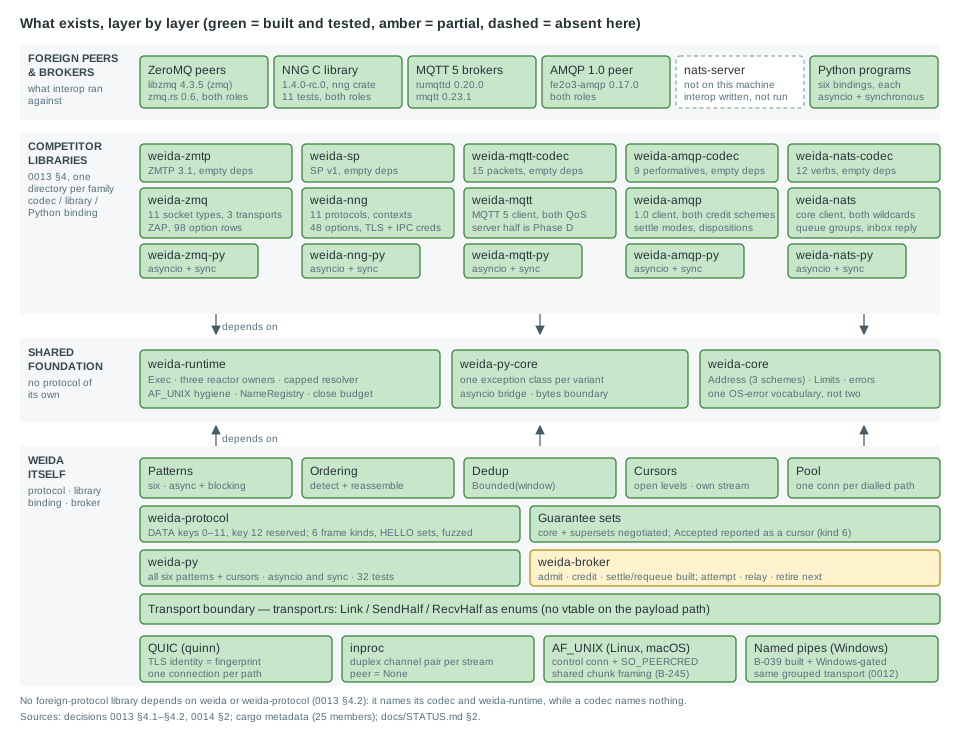
The load-bearing line is the transport boundary: Link, SendHalf, RecvHalf as enums in crates/weida/src/transport.rs. Everything above it is transport-blind, and tests/transports.rs now runs all six patterns over QUIC, inproc, AF_UNIX and, on Windows, named pipes. Below it the two kernel-mediated transports share one implementation of the 0012 grouping and the same per-write framing, generic over what a socket and a pipe differ in; that shared framing is what made an interrupted AF_UNIX stream distinguishable from FIN (B-245).
The reactor is its own crate now: weida-runtime holds Exec, the three reactor-ownership constructors, the capped resolver, the AF_UNIX and named-pipe hygiene and the name registry, and it depends on weida-core, tokio and — on Windows only — weida-winpipe, the one crate in the tree that may use unsafe, fifteen Win32 calls behind a safe surface — which is what lets a ZeroMQ user open a socket without linking quinn, rustls and weida's pattern layer. Above it the tree is one directory per protocol family (crates/zmq/, crates/nng/, crates/interop/) rather than one adapters/ bucket, so the directory list answers "does this repository ship a ZeroMQ?". Each codec crate still has an empty [dependencies] section, so it can be checked against its RFC rather than against our reading of it; each library depends on the codec and the runtime and never on weida; each forwarder is the only crate that names both sides. The review pass of B-051 found the session's first two unbounded remote-influenced allocations in a bridge rather than in the core, and B-097 found two more in the new library — so the invariant sweep covers the foreign-protocol crates too, and every bound they added is named where it is taken.
Completions are cursors, on a stream of their own. weida::Cursors, weida::CursorSet and weida::Reporter (B-233, B-240) are the acknowledgement surface of 0023 and 0024: a sender orders levels per transfer with TransferMeta::with_report and reads absolute byte offsets back on frame kind 6, a unidirectional stream that never shares a stream with payload. Two properties are structural rather than promised. No pattern's topology changes: a Push transfer that orders cursors is still one unidirectional stream, proved against a raw quinn peer because the library's own API cannot assert it. And nothing waits on a cursor: a sender that never reads its cursors blocks no transfer, a receiver that never reports fails none, and the level space is open — 0..=15 is weida's ladder, 16 and above is the application's, carried and ordered but never interpreted. weida-broker is the first user: a Push producer that orders Accepted gets it at the admitted body length on one unidirectional stream, with no exchange and no reply half, while an exchange's publisher confirm stays the DATA key 8 reply it always was. A level the broker cannot reach — Stored, with no store — is absent from the report rather than failed, which is GUARANTEES.md §1's prohibition seen from the reporting side.
The broker now owns a delivery until somebody reports it processed. B-201 admits and confirms at Accepted; B-202 registers ordinary subscribers and delivers under their cumulative credit; B-203 moves each delivery into an unsettled table without releasing its queue_bytes charge. The consumer's Processed cursor settles it, while a report that ends without one requeues it at the head. max_unsettled is a live per-subscription bound, not a clamp on lifetime credit. What is not built is kept separate and named: B-267 exposes the attempt count on DATA key 12, B-268 relays a consumer report toward the producer under the producer's report id, and B-269 adds retire(deadline).
The pattern family is complete. Req/Rep, Push/Pull and Pub/Sub were already there; PAIR, SURVEY and BUS (B-236, B-237, B-238) close ARCHITECTURE.md §6b's table and with it the nanomsg set — and they cost no wire vocabulary at all: a weida::Paired talks to a bare Peer and Acceptor on the same path, a Respondent's route is byte-for-byte a replier's, a BusMember's is a puller's. Each needed exactly one thing the mapping had not seen, and each is where a hand-built version goes wrong: PAIR refuses a second peer with LIMIT_EXCEEDED and keeps the first, a survey counts a late reply where it arrives rather than where the caller reads, and a bus needs a writer per member — without one a single member that stops reading blocks the sender.
3. Progress by the numbers
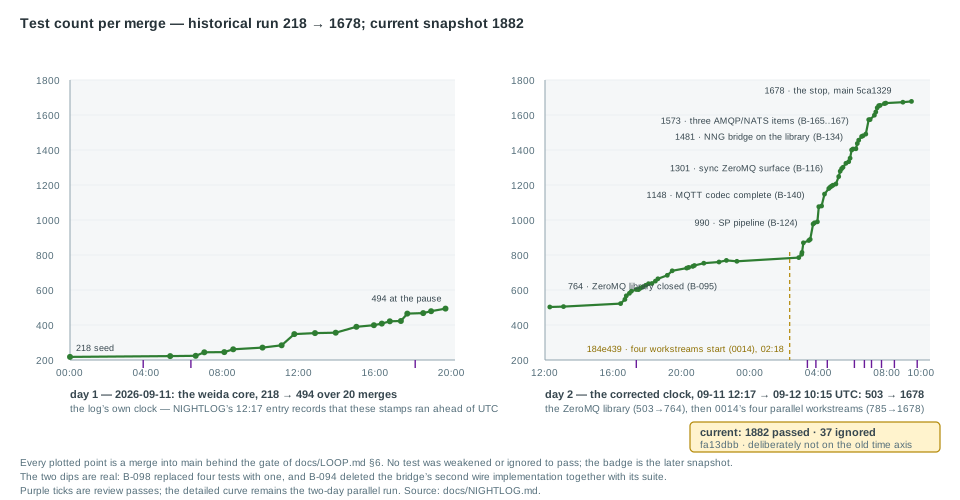
Every plotted point in the two panels is a merge into main behind the gate that existed when the parallel run was made. The detailed curve deliberately stops at that run's two-day stop (5ca1329, 1678 passed); the diagram now carries a separate, explicitly non-time-scaled current badge instead of pretending the intervening three days fit the old axis. That badge is the snapshot above: 1882 passed at fa13dbb, 37 ignored. The two dips in the historical curve are real deletions: B-098 replaced four weaker tests with one, and B-094 removed the bridge's second wire implementation together with its suite.
5. The measurements that decided something
| Question | Number | What it decided |
|---|---|---|
| Two extra DATA keys per message | +80 B, −9 % msg/s (B-009) | producer identity travels as a 32-byte bstr, not hex (0008 §4.4) |
| Reorder buffer under reverse completion | peak N − 1; 84 of 256 unforced (B-010) | max_reorder_hold is a configured number, default 256 |
| Second connection per peer | 1.05 ms handshake, ~1 MiB per pair (B-011/012) | one connection per dialled path is affordable (B-017) |
| Segment matcher in the fan-out path | 14 ns per filter, shape-independent (B-021) | the grammar is not the cost; registry iteration is |
| Parking a drain receipt on drop | first cut −3 %, per-connection inside noise (B-032) | per-connection parking; "dropping a Delivery is free" rewritten |
| Dedup key allocation | ~10 ns; the fix measures the same (B-040) | key left alone, with the number beside it |
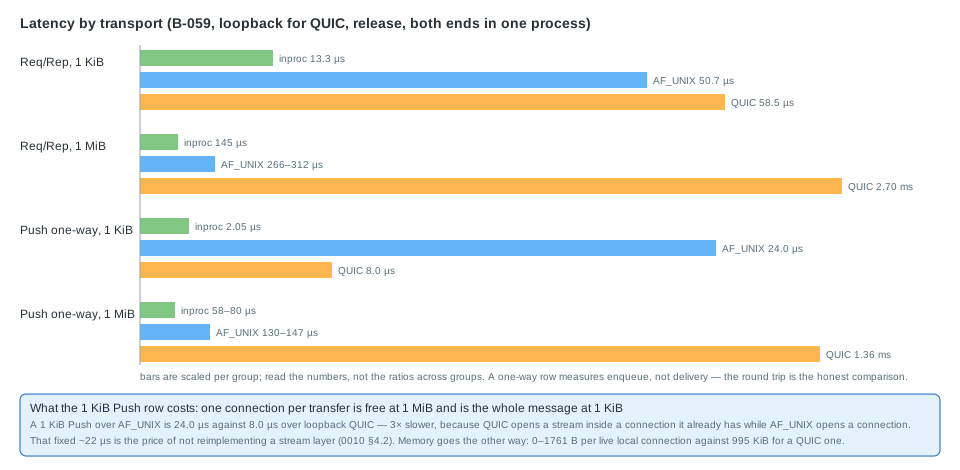
| Local transports against QUIC | Req/Rep 1 KiB 13 µs inproc, 51 µs unix, 58 µs QUIC; Push 1 KiB 24 µs unix against 8 µs QUIC (B-059) | a local open waits for a slot, and 0010 §4.2's "the connection is the stream" is priced: free at 1 MiB, the whole cost at 1 KiB |
6. What needs a human
No unresolved design question gates the next ready item. Six entries record what was decided, what remains deliberately manual and which machine fact currently limits a second-platform proof.
- B-203 is built, not waiting on the conversation any more. 0029 supplied the rule; B-203 supplied settlement and requeue. A queue's own certificate remains
Accepted, while the consumer'sProcessedis a report that may be relayed as the consumer's — never invented, never re-relayed. No visibility timer was added: QUIC retransmits lost packets, a lost subscription requeues, and a live but silent consumer is bounded bymax_unsettled. The three consequences intentionally split out are ready as B-267, B-268 and B-269. - Phase C's order and the PyPy answer are written down. 0030 records Python, Node, Erlang, C, Java: one N-API artifact targets Node, Bun and Deno; Rustler can send completions into a BEAM mailbox; the C ABI serves runtimes without a Rust-native bridge; Java stays last rather than being dropped. B-266 answered no to a second PyPy client: the measured cost is one event-loop wakeup per
await, not bytecode. B-265, the separate Erlang-distribution sheet, is parked until the Erlang row. - The website and CI are parked by the owner, not blocked on code. The site renders 58 pages from this tree and fails its build on a dangling link, but remains local while the workspace is unpublished and untagged (B-254). Since superseded: 0033 moved the site to its own repository after the first crates.io release. CI is the owner's separate project (B-061); this tree supplies a reproducible gate rather than a workflow file.
- The gate's blind spots are closed. LOOP §6 names all five default-off configurations and ten explicit rustdoc configurations, with
cargo clean --docfirst. The feature matrix had 850 tests when the rule was measured and has 854 now, because B-203 added four broker tests that also run withcluster. - Windows stays manual and its toolchain currently needs rebuilding. The btrfs/QEMU
cache=nonefailure was fixed by creating the VM images withNo_COW; the replacement guest is reachable but has no Rust, git or MSVC yet, soC:\work\gate.ps1is not presently runnable. The unrelated 980 PRO mounted at/mnt/winstill reports 630 media/data-integrity errors and still needs the owner's backup. - The two peer-visible review decisions are closed. A trace context is propagated and never minted (0028, B-246), taking a 64-byte push from 135 B to 76 B; and the named-pipe chunk framing is now shared with
AF_UNIX, so cancellation cannot read as successful FIN (B-245).
7. Where the loop stands
- Nothing is in flight and the tree is clean at
fa13dbb. The required Linux gate is green at 1882 passed, 0 failed, 37 ignored, the five default-off configurations add 854 passed, and all ten rustdoc configurations are clean after the doc cache is removed. The only unrun cross-check is Windows, for the missing guest toolchain named above; no LOOP §6 configuration is red. - 8 items are
ready, 16 areblocked, 4 areparked; of 265 filed items, 237 aredone. The ready list is exact: B-267, B-268 and B-269 finish the broker outcome sequence, then B-231, B-226, B-219, B-220 and B-224 are the five cluster/store slices. The first three are independent cuts rather than one hidden mega-item: wire-visible attempt count, report relay across two connections, and finite queue retirement. Every surface already built in Rust is bound inweida::blockingand bothweida-pyhalves. - The requirement-driven backlog is closed. All five requests of requirements/zeughaus-video.md are answered where they were filed: streaming fan-out built (B-064,
Publisher::open), conflation answered without a key (B-065, 0016), peer authorization answered "neither" (B-066, 0015), per-topic drop counters built (B-067), and the dependency form blocked on the licence above (B-068). - What the previous session closed: B-177 (split a
weida-zmqsocket into halves — the library diff removes 691 lines while adding 493, because the pattern bodies the whole sockets had are now shared), B-096 (a byte ceiling per peer queue, where a message count never was one), B-064 (streaming fan-out), B-060 (theweidabinary, Phase 11's first slice) with B-195..B-197 on top of it, B-194 (weida::blocking), B-065, B-066, B-193 and the two consequence passes B-191/B-192, plus the evidence passes on B-107, B-184 and B-068. Ten items were filed to replenish the backlog (B-191..B-200) and a review pass was logged atdb5c144: 0 new findings, and the allocation sweep's best answer is that the pipe transport's chunk header declares au32length and allocates nothing from it. - What this session closed: the acknowledgement model, the complete pattern family and the first useful outcome half of the broker. B-233/B-239/B-240 built frame kind
6, cursors, report modes and reporter-owned granularity; B-236/B-237/B-238 built PAIR, SURVEY and BUS; B-242 proved the failure matrix; B-243 and B-244 carried every new surface into blocking Rust and Python. B-203 then made a delivery a retained responsibility rather than a deletion: settle onProcessed, requeue when the report disappears, and retain the byte charge while unsettled. 0029 records why a report may travel where a certificate may not, and 0030 records the runtime order instead of leaving it as an assertion in the roadmap. - A coherence sweep closed the session, seven parallel read-only audits over code, docs, decision notes, bindings and the five foreign-protocol libraries. Fifteen incoherences, all of the same four kinds: counts that had become false, superseded claims (including
GUARANTEES.mdcontradicting itself on whether an acknowledgement level has a wire representation), former adapter mappings that treated protocol similarities as global, and claims of completeness in the surfaces this plan deliberately left alone. The only code finding was settled by a test rather than an argument:tests/transports.rsnow runs all six patterns over every transport, andpair_over_unixis the first thing here that proves the reverse pool of 0012 §4.4 carries an ordinary send rather than a fan-out copy. - What moves next is no longer a human choice: B-267 is the first ready item. It puts
delivery_attempton DATA key12without mixing that wire change into B-203's behavior slice; B-268 and B-269 follow. The five ready cluster/store slices stay behind those three in backlog order. Node is the next Phase C row by 0030, but no binding item has been filed or started.